Buy mentorcoaching.eu ?
We are moving the project
mentorcoaching.eu .
Are you interested in purchasing the domain
mentorcoaching.eu ?
domain@kv-gmbh.de · 0541-91531010
Buy mentorcoaching.eu ?
Does stupidity refer to intelligence or education?
Stupidity generally refers to a lack of intelligence or common sense rather than a lack of education. Intelligence is often seen as the ability to learn, understand, and apply knowledge, while education is the formal process of acquiring knowledge and skills. Someone can be highly educated but still make foolish decisions or lack critical thinking skills, which may be perceived as stupidity. On the other hand, someone with lower levels of education can still demonstrate intelligence through problem-solving abilities and logical reasoning. **
Is intelligence inherited or influenced by education?
Intelligence is influenced by a combination of both genetic inheritance and education. Research has shown that genetics play a significant role in determining intelligence, but education and environmental factors also play a crucial role in shaping and developing intelligence. While genetics may provide a foundation for intelligence, education and learning experiences can help to enhance and refine cognitive abilities. Therefore, both genetic inheritance and education have a significant impact on an individual's intelligence. **


Similar search terms for Intelligence
Top-Angebote
Products related to Intelligence:
-
Uplifted Finds Titan Flow Wireless 3.2L Intelligence Station Titan Flow Wireless 3.2L Intelligence StationAchieve total liberation from poweroutlet proximity with the TitanFlow Wireless Station, a highperformance hydration module engineered with dualmode intelligentsensor logic. This professionalgrade fountain features a 4000mAh highcapacity battery...389,97 $*Shipping: 0,00 $Secure redirect to the provider
-
Lolly Daskal, Robin Sharma Daniel H. Pink,Daniel Goleman Leadership Gap,Drive Daniel Pink, The Leader Who Had No Title, Emotional Intelligence, Working with Emotional Intelligence 5 Books Collection SetDescription:. Condition: BRAND NEW. Format: Mixed lot. Leadership Gap [Hardcover]:. Do people see you as the kind of leader you want to be? Are your strongest leadership qualities getting in the way of your greatness? After decades of advising and inspiring some of the most eminent chief executives in the world, Lolly Daskal has uncovered a startling pattern.. Drive Daniel Pink:. Forget everything you thought you knew about how to motivate people - at work, at school, at home. It is wrong. As Daniel H. Pink explains in his paradigm-shattering book Drive, the secret to high performance and satisfaction in today's world is the deeply human need to direct our own lives.. The Leader Who Had No Title:. Robin Sharma believes there are certain skills and attitudes that allow you to rise to extraordinary success. In his powerful new parable, he offers a story designed to help people from all walks of life to achieve great things.. Emotional Intelligence:. The groundbreaking bestseller that redefines intelligence and success Does IQ define our destiny? Daniel Goleman argues that our view of human intelligence is far too narrow, and that our emotions play major role in thought, decision making and individual success.. Working with Emotional Intelligence:. Do you want to be more successful at work? Do you want to improve your chances of promotion? Do you want to get on better with your colleagues? Daniel Goleman draws on unparalleled access to business leaders around the world and the thorough research that is his trademark.. Title. Delivery. Content. Reviews99,99 £*Shipping: 0,00 £Secure redirect to the provider
-
Macmillan Business Leadership Intelligence: Twenty-One Everyday Management Challenges and How to Master Them - Non Fiction - PaperbackTitle:. Leadership Intelligence: Twenty-One Everyday Management Challenges and How to Master Them Overview:. Stepping into a role of authority demands more than good intentions; it requires a reliable framework for navigating the complex realities of modern workplaces. Leadership Intelligence: Twenty-One Everyday Management Challenges and How to Master Them serves as a pragmatic handbook designed to bridge the gap between theoretical management concepts and the daily pressures faced by active leaders. This essential paperback collection focuses squarely on the recurring friction points that drain energy, stall progress, and test managerial confidence. By structuring guidance around twenty-one distinct challenges, the book offers readers a manageable yet comprehensive roadmap for cultivating the cognitive agility and emotional resilience necessary to lead effectively. Whether you are managing a small team, overseeing cross-functional projects, or transitioning into your first supervisor role, this resource addresses the tangible problems that define the management experience. The volume is crafted to empower readers with actionable insights, helping to transform obstacles into opportunities for team development and personal growth. What Makes This Book Stand Out:. Unlike comprehensive textbooks that bury actionable advice under academic jargon, this title prioritises clarity and implementation. The decision to organise content around twenty-one specific challenges creates a focused reading journey that resonates with professionals who need immediate relevance. Each segment targets a genuine workplace scenario, encouraging readers to reflect on their own behaviours and adjust their approaches accordingly. This structure supports high engagement, allowing busy individuals to dip in and out for practical solutions without losing continuity. Furthermore, the emphasis on "leadership intelligence" signals a holistic approach that blends strategic thinking with interpersonal skills. It recognises that mastering management is not merely about processes but also about understanding human dynamics, adapting communication styles, and maintaining composure under pressure. The inclusion of "how to master them" promises a results-oriented focus, ensuring that every chapter moves beyond problem identification to deliver empowering strategies that readers can apply immediately. Who This Book Is Perfect For:. This publication is carefully curated for a broad spectrum of professionals seeking to sharpen their management capabilities. Newly promoted leaders often struggle with the sudden shift from peer to boss, and this book provides a vital safety net of insights for navigating that transition with poise. Seasoned managers will also find immense value in reviewing foundational challenges with fresh perspective, using the twenty-one-point framework to refresh outdated habits. Team leads, project coordinators, and department heads facing ongoing personnel issues,...25,00 £*Shipping: 2,99 £Secure redirect to the provider


-
Is school education crucial for a person's intelligence?
School education plays a significant role in shaping a person's intelligence by providing them with foundational knowledge, critical thinking skills, and exposure to various subjects. However, intelligence is a complex trait influenced by a combination of factors, including genetics, environment, and life experiences. While school education can enhance cognitive abilities and academic skills, intelligence is not solely determined by formal education. Personal experiences, curiosity, and continuous learning outside of school also contribute to a person's overall intelligence. **
-
Does intelligence have anything to do with education?
Intelligence and education are related but not synonymous. Intelligence is a person's ability to learn, understand, and apply knowledge, while education is the formal process of acquiring knowledge and skills through instruction or study. While education can enhance and develop a person's intelligence, intelligence itself is an inherent trait that is not solely dependent on formal education. People can be intelligent without formal education, and conversely, individuals with extensive education may not necessarily be considered highly intelligent. **
-
Is formal education crucial for a person's intelligence?
Formal education can certainly play a significant role in developing a person's intelligence by providing structured learning opportunities, access to knowledge, and critical thinking skills. However, intelligence is a complex trait influenced by various factors such as genetics, environment, and life experiences. While formal education can enhance intelligence, it is not the sole determinant. Individuals can also cultivate their intelligence through self-directed learning, curiosity, and real-world experiences. **
-
What does intelligence have to do with education?
Intelligence plays a significant role in education as it can impact a student's ability to comprehend and process information, solve problems, and learn new concepts. Educators often tailor their teaching methods to accommodate different levels of intelligence, and intelligence testing can help identify students who may need additional support or advanced learning opportunities. Additionally, education can also help to develop and enhance intelligence through critical thinking, problem-solving, and exposure to new ideas and knowledge. Ultimately, intelligence and education are interconnected, with education serving as a means to nurture and develop intelligence. **

Is there a causality between education and intelligence?
There is a strong correlation between education and intelligence, but it is important to note that correlation does not necessarily imply causation. Education can certainly enhance and develop one's intelligence through exposure to new ideas, critical thinking skills, and problem-solving abilities. However, intelligence is also influenced by genetic factors and other environmental factors. Therefore, while education can contribute to the development of intelligence, it is not the sole determinant. **
Are intelligence and education related to each other?
Intelligence and education are related, but they are not the same thing. Intelligence refers to a person's cognitive abilities, problem-solving skills, and overall mental capacity, while education refers to the knowledge and skills acquired through formal learning and instruction. While a person's level of intelligence can influence their ability to learn and succeed in education, education can also enhance and develop a person's intelligence through exposure to new ideas, critical thinking, and problem-solving. Therefore, while intelligence and education are related, they are not synonymous, and one does not necessarily determine the other. **
Top-Angebote
Products related to Intelligence:
-
Uplift Essentials Wooden Montessori Abacus & Intelligence Development Toy woodAccelerate your child's cognitive foundation with a hightactile mathematical solution designed for early mastery. This wooden abacus for kids is a professionalgrade intelligence development tool engineered to transform abstract numbers into...39,97 $*Shipping: 0,00 $Secure redirect to the provider
-
Uplifted Finds Montessori Wooden Bell Rattle BPA Free Intelligence Development & Teething Toy 2Command ultimate pediatric confidence with the AcousticKinetic Montessori System, a highperformance developmental solution specifically engineered to act as a comprehensive tool for elite organization and superior technical ergonomics. Built with a...39,97 $*Shipping: 0,00 $Secure redirect to the provider
-
Uplifted Finds Titan Flow Wireless 3.2L Intelligence Station Titan Flow Wireless 3.2L Intelligence StationAchieve total liberation from poweroutlet proximity with the TitanFlow Wireless Station, a highperformance hydration module engineered with dualmode intelligentsensor logic. This professionalgrade fountain features a 4000mAh highcapacity battery...389,97 $*Shipping: 0,00 $Secure redirect to the provider
-
Does stupidity refer to intelligence or education?
Stupidity generally refers to a lack of intelligence or common sense rather than a lack of education. Intelligence is often seen as the ability to learn, understand, and apply knowledge, while education is the formal process of acquiring knowledge and skills. Someone can be highly educated but still make foolish decisions or lack critical thinking skills, which may be perceived as stupidity. On the other hand, someone with lower levels of education can still demonstrate intelligence through problem-solving abilities and logical reasoning. **
-
Is intelligence inherited or influenced by education?
Intelligence is influenced by a combination of both genetic inheritance and education. Research has shown that genetics play a significant role in determining intelligence, but education and environmental factors also play a crucial role in shaping and developing intelligence. While genetics may provide a foundation for intelligence, education and learning experiences can help to enhance and refine cognitive abilities. Therefore, both genetic inheritance and education have a significant impact on an individual's intelligence. **
-
Is school education crucial for a person's intelligence?
School education plays a significant role in shaping a person's intelligence by providing them with foundational knowledge, critical thinking skills, and exposure to various subjects. However, intelligence is a complex trait influenced by a combination of factors, including genetics, environment, and life experiences. While school education can enhance cognitive abilities and academic skills, intelligence is not solely determined by formal education. Personal experiences, curiosity, and continuous learning outside of school also contribute to a person's overall intelligence. **
-
Does intelligence have anything to do with education?
Intelligence and education are related but not synonymous. Intelligence is a person's ability to learn, understand, and apply knowledge, while education is the formal process of acquiring knowledge and skills through instruction or study. While education can enhance and develop a person's intelligence, intelligence itself is an inherent trait that is not solely dependent on formal education. People can be intelligent without formal education, and conversely, individuals with extensive education may not necessarily be considered highly intelligent. **
Similar search terms for Intelligence
-
Lolly Daskal, Robin Sharma Daniel H. Pink,Daniel Goleman Leadership Gap,Drive Daniel Pink, The Leader Who Had No Title, Emotional Intelligence, Working with Emotional Intelligence 5 Books Collection SetDescription:. Condition: BRAND NEW. Format: Mixed lot. Leadership Gap [Hardcover]:. Do people see you as the kind of leader you want to be? Are your strongest leadership qualities getting in the way of your greatness? After decades of advising and inspiring some of the most eminent chief executives in the world, Lolly Daskal has uncovered a startling pattern.. Drive Daniel Pink:. Forget everything you thought you knew about how to motivate people - at work, at school, at home. It is wrong. As Daniel H. Pink explains in his paradigm-shattering book Drive, the secret to high performance and satisfaction in today's world is the deeply human need to direct our own lives.. The Leader Who Had No Title:. Robin Sharma believes there are certain skills and attitudes that allow you to rise to extraordinary success. In his powerful new parable, he offers a story designed to help people from all walks of life to achieve great things.. Emotional Intelligence:. The groundbreaking bestseller that redefines intelligence and success Does IQ define our destiny? Daniel Goleman argues that our view of human intelligence is far too narrow, and that our emotions play major role in thought, decision making and individual success.. Working with Emotional Intelligence:. Do you want to be more successful at work? Do you want to improve your chances of promotion? Do you want to get on better with your colleagues? Daniel Goleman draws on unparalleled access to business leaders around the world and the thorough research that is his trademark.. Title. Delivery. Content. Reviews99,99 £*Shipping: 0,00 £Secure redirect to the provider
-
Macmillan Business Leadership Intelligence: Twenty-One Everyday Management Challenges and How to Master Them - Non Fiction - PaperbackTitle:. Leadership Intelligence: Twenty-One Everyday Management Challenges and How to Master Them Overview:. Stepping into a role of authority demands more than good intentions; it requires a reliable framework for navigating the complex realities of modern workplaces. Leadership Intelligence: Twenty-One Everyday Management Challenges and How to Master Them serves as a pragmatic handbook designed to bridge the gap between theoretical management concepts and the daily pressures faced by active leaders. This essential paperback collection focuses squarely on the recurring friction points that drain energy, stall progress, and test managerial confidence. By structuring guidance around twenty-one distinct challenges, the book offers readers a manageable yet comprehensive roadmap for cultivating the cognitive agility and emotional resilience necessary to lead effectively. Whether you are managing a small team, overseeing cross-functional projects, or transitioning into your first supervisor role, this resource addresses the tangible problems that define the management experience. The volume is crafted to empower readers with actionable insights, helping to transform obstacles into opportunities for team development and personal growth. What Makes This Book Stand Out:. Unlike comprehensive textbooks that bury actionable advice under academic jargon, this title prioritises clarity and implementation. The decision to organise content around twenty-one specific challenges creates a focused reading journey that resonates with professionals who need immediate relevance. Each segment targets a genuine workplace scenario, encouraging readers to reflect on their own behaviours and adjust their approaches accordingly. This structure supports high engagement, allowing busy individuals to dip in and out for practical solutions without losing continuity. Furthermore, the emphasis on "leadership intelligence" signals a holistic approach that blends strategic thinking with interpersonal skills. It recognises that mastering management is not merely about processes but also about understanding human dynamics, adapting communication styles, and maintaining composure under pressure. The inclusion of "how to master them" promises a results-oriented focus, ensuring that every chapter moves beyond problem identification to deliver empowering strategies that readers can apply immediately. Who This Book Is Perfect For:. This publication is carefully curated for a broad spectrum of professionals seeking to sharpen their management capabilities. Newly promoted leaders often struggle with the sudden shift from peer to boss, and this book provides a vital safety net of insights for navigating that transition with poise. Seasoned managers will also find immense value in reviewing foundational challenges with fresh perspective, using the twenty-one-point framework to refresh outdated habits. Team leads, project coordinators, and department heads facing ongoing personnel issues,...25,00 £*Shipping: 2,99 £Secure redirect to the provider
-
Ethan Mollick, Prof. V.K.Simon Co-Intelligence, Enhancing Your Leadership Skills, Counseling Skills For Managers 3 Book SetDescription. Condition: BRAND NEW. Format: Paperback. Co-Intelligence: Living and Working with AI. Cutting through the noise of AI evangelists and AI doom-mongers, Wharton professor Ethan Mollick has become one of the most prominent and provocative explainers of AI, focusing on the practical aspects of how these new tools for thought can transform our world. In Co-Intelligence, he urges us to engage with AI as co-worker, co-teacher and coach. Wide ranging, hugely thought-provoking and optimistic, Co-Intelligence reveals the promise and power of this new era.. Enhancing Your Leadership Skills: A Practical Handbook for Success. Embark on a transformative journey with "Enhancing Your Leadership Skills," where you'll master the essentials of self- awareness and emotional intelligence, and tackle the complexities of global leadership. From crafting a clear vision and setting effective goals to honing your communication skills and making strategic decisions, this resource is your pathway to becoming a more impactful leader.. Counseling Skills For Managers : Exploring Approaches, Skills and Ethical Considerations for Effective Leadership. Step into the future of leadership with "Counseling Skills for Managers," a dynamic book designed to help managers achieve new levels of productivity and interpersonal understanding. In today's complex corporate environment, understanding the skill of advising is not only advantageous but also necessary. This comprehensive book begins with the fundamental principles of counseling and goes to strategic applications in corporate settings, allowing you to improve communication, settle problems, and promote team morale.. Title. Co-Intelligence: Living and Working with AI, Enhancing Your Leadership Skills: A Practical Handbook for Success, Counseling Skills For Managers : Exploring Approaches, Skills and Ethical Considerations for Effective Leadership 3 Book Set. Delivery. Content. Reviews21,99 £*Shipping: 2,99 £Secure redirect to the provider
-
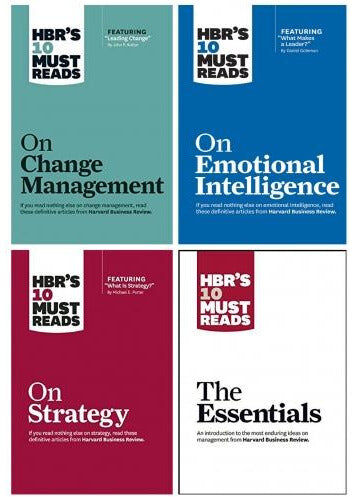
Harvard Business Review Press Hbrs 10 Must Reads Leadership Collection 4 Books Set - The Essentials Emotional Intelligence Strat..HBRs 10 Must Reads Leadership Collection 4 Books Set Description Change Management If you read nothing else on change management; read these 10 articles (featuring 'Leading Change; by John P. Kotter). We have combed through hundreds of Harvard Business Review articles and selected the most important ones to help you spearhead change in your organization. HBRs 10 Must Reads on Change Management will inspire you to: Lead change through eight critical stages Establish a sense of urgency Overcome addiction to the status quo Mobilize commitment Silence naysayers Minimize the pain of change Concentrate resources Motivate change when business is good Strategy If you read nothing else on strategy; read these 10 articles (featuring 'What Is Strategy? by Michael E. Porter). We have combed through hundreds of Harvard Business Review articles and selected the most important ones to help you catalyze your organization's strategy development and execution. HBRs 10 Must Reads on Strategy will inspire you to: Distinguish your company from rivals Clarify what your company will and won't do Craft a vision for an uncertain future Create blue oceans of uncontested market space Use the Balanced Scorecard to measure your strategy Capture your strategy in a memorable phrase Make priorities explicit Allocate resources early Clarify decision rights for faster decision making The Essentials Change is the one constant in business; and we must adapt or face obsolescence. Yet certain challenges never go away. Thats what makes this book 'must read.' These are the 10 seminal articles by managements most influential experts; on topics of perennial concern to ambitious managers and leaders hungry for inspiration--and ready to run with big ideas to accelerate their own and their companies success. If you read nothing else - full stop - read: Michael Porter on creating competitive advantage and distinguishing your company from rivals John Kotter on leading change through eight critical stages Daniel Goleman on using emotional intelligence to maximize performance Peter Drucker on managing your career by evaluating your own strengths and weaknesses Clay Christensen on orchestrating innovation within established organizations Tom Davenport on using analytics to determine how to keep your customers loyal Robert Kaplan and David Norton on measuring your company's strategy with the Balanced Scorecard Rosabeth Moss Kanter on avoiding common mistakes when pushing innovation forward Ted Levitt on understanding who your customers are and what they really want C. K. Prahalad and Gary Hamel on identifying the unique; integrated systems that support your strategy Emotional Intelligence If you read nothing else on emotional intelligence; read these 10 articles by experts in the field. We have combed through hundreds of articles in the Harvard Business Review archive and selected the most important ones to help you boost your emotional skills and your professional success. This book will inspire...34,95 £*Shipping: 2,99 £Secure redirect to the provider
-
Is formal education crucial for a person's intelligence?
Formal education can certainly play a significant role in developing a person's intelligence by providing structured learning opportunities, access to knowledge, and critical thinking skills. However, intelligence is a complex trait influenced by various factors such as genetics, environment, and life experiences. While formal education can enhance intelligence, it is not the sole determinant. Individuals can also cultivate their intelligence through self-directed learning, curiosity, and real-world experiences. **
-
What does intelligence have to do with education?
Intelligence plays a significant role in education as it can impact a student's ability to comprehend and process information, solve problems, and learn new concepts. Educators often tailor their teaching methods to accommodate different levels of intelligence, and intelligence testing can help identify students who may need additional support or advanced learning opportunities. Additionally, education can also help to develop and enhance intelligence through critical thinking, problem-solving, and exposure to new ideas and knowledge. Ultimately, intelligence and education are interconnected, with education serving as a means to nurture and develop intelligence. **
-
Is there a causality between education and intelligence?
There is a strong correlation between education and intelligence, but it is important to note that correlation does not necessarily imply causation. Education can certainly enhance and develop one's intelligence through exposure to new ideas, critical thinking skills, and problem-solving abilities. However, intelligence is also influenced by genetic factors and other environmental factors. Therefore, while education can contribute to the development of intelligence, it is not the sole determinant. **
-
Are intelligence and education related to each other?
Intelligence and education are related, but they are not the same thing. Intelligence refers to a person's cognitive abilities, problem-solving skills, and overall mental capacity, while education refers to the knowledge and skills acquired through formal learning and instruction. While a person's level of intelligence can influence their ability to learn and succeed in education, education can also enhance and develop a person's intelligence through exposure to new ideas, critical thinking, and problem-solving. Therefore, while intelligence and education are related, they are not synonymous, and one does not necessarily determine the other. **
* All prices are inclusive of VAT and, if applicable, plus shipping costs. The offer information is based on the details provided by the respective shop and is updated through automated processes. Real-time updates do not occur, so deviations can occur in individual cases. ** Note: Parts of this content were created by AI.